SERVING WA
Since 2009

Yes—gondola shelving is worth it for a small grocery store in 2026 when it gives your packaged stock enough display space without squeezing customer movement or replenishment access. The decision must also account for the complete shelving configuration, shelf-edge ticketing and installation requirements, not just the shelving frame.
Gondola shelving is worth buying when the proposed layout solves a stock-display problem without creating an access problem. A small grocery store needs both: enough shelf space for its range and a floor plan that customers and staff can use comfortably.
Start with a sketch showing entrances, checkout queues, refrigeration, doors and existing fixtures. The gondola shelving to full store layout workflow addresses the same planning sequence: assess the whole shop before choosing individual bays.
| Layout option | Best for | Main advantage | Main limitation |
|---|---|---|---|
| Wall shelving | Groceries with limited central floor space | Keeps the centre available for circulation | Display length depends on usable wall space |
| Double-sided centre gondolas | Shops with room for customer access on both sides | Presents stock towards adjoining aisles | Requires space for the fixture and surrounding routes |
| Phased fit-out | Operators testing a revised grocery range | Lets the layout respond to actual stock needs | Requires another planning and installation stage later |
Choose the layout first and the shelving configuration second. A larger display is not better if it blocks the route to everyday purchases or leaves staff unable to replenish without obstructing customers.
In a small grocery store, fixtures compete with everything else that needs floor space. Refrigeration doors must open, customers need to reach the checkout, and staff need somewhere to stand while replacing stock.
Buying shelves before resolving those competing uses leaves the layout dependent on whatever fits afterwards. For your 2026 fit-out, mark the working routes before allocating the remaining space to displays.
The practical test is not whether another bay fits on paper. It is whether the store still works with customers browsing, a queue forming and stock being put away.
Wall shelving is the stronger starting point when your shop has usable perimeter space but little room for another aisle. It gives packaged groceries a defined display area without immediately committing the centre of the store to a shelving run.
Check the wall position against doors, switches, services and nearby refrigeration. Confirm the fixture's installation and restraint requirements rather than assuming that placing it against a wall makes it secure.
The limitation is available wall length. A perimeter-only layout also needs a deliberate category sequence so customers can find related products without repeatedly crossing the shop.
Recommendation: choose wall shelving first when a centre run would compromise the routes your store needs. Do not treat every empty stretch of wall as suitable shelving space until its access requirements are checked.
Double-sided centre gondolas suit a floor plan that supports browsing on both sides and movement around the ends. They organise packaged grocery categories into distinct runs, provided the fixture height and position suit the shop's sightlines.
Draw the complete fixture footprint, including projecting components, before assessing the surrounding space. Then check the approach to the checkout and any route customers use to reach chilled goods.
The trade-off is circulation space. A centre fixture that looks compact in isolation still needs access around it, and an end display must not consume the route left clear on the plan.
Recommendation: choose centre gondolas only after testing the surrounding customer and replenishment routes. Leave the central floor open if that test fails.
A phased fit-out suits an operator who is still deciding how much space each category deserves. Plan the full store, but order the confirmed configuration rather than filling every possible position immediately.
This approach keeps fixture decisions tied to the range you intend to sell. It also leaves room to reconsider a category that needs a different display arrangement.
The drawback is another ordering and installation exercise. Ask about component compatibility before relying on future additions, because a similar appearance does not establish that shelving parts work together.
Recommendation: stage the purchase when the assortment is unsettled, but document the intended finished layout before the first order.
The value of gondola shelving depends on the relationship between your shop, your stock and the complete configuration. Use these factors to assess a proposed 2026 layout:
These factors are more useful than choosing on appearance alone. A tidy-looking fixture still needs to hold the intended products safely and support the way your store operates.
Use this sequence to turn a general shelving idea into a buying brief. Keep the drawing and stock list together so a change to either triggers a review of the other.
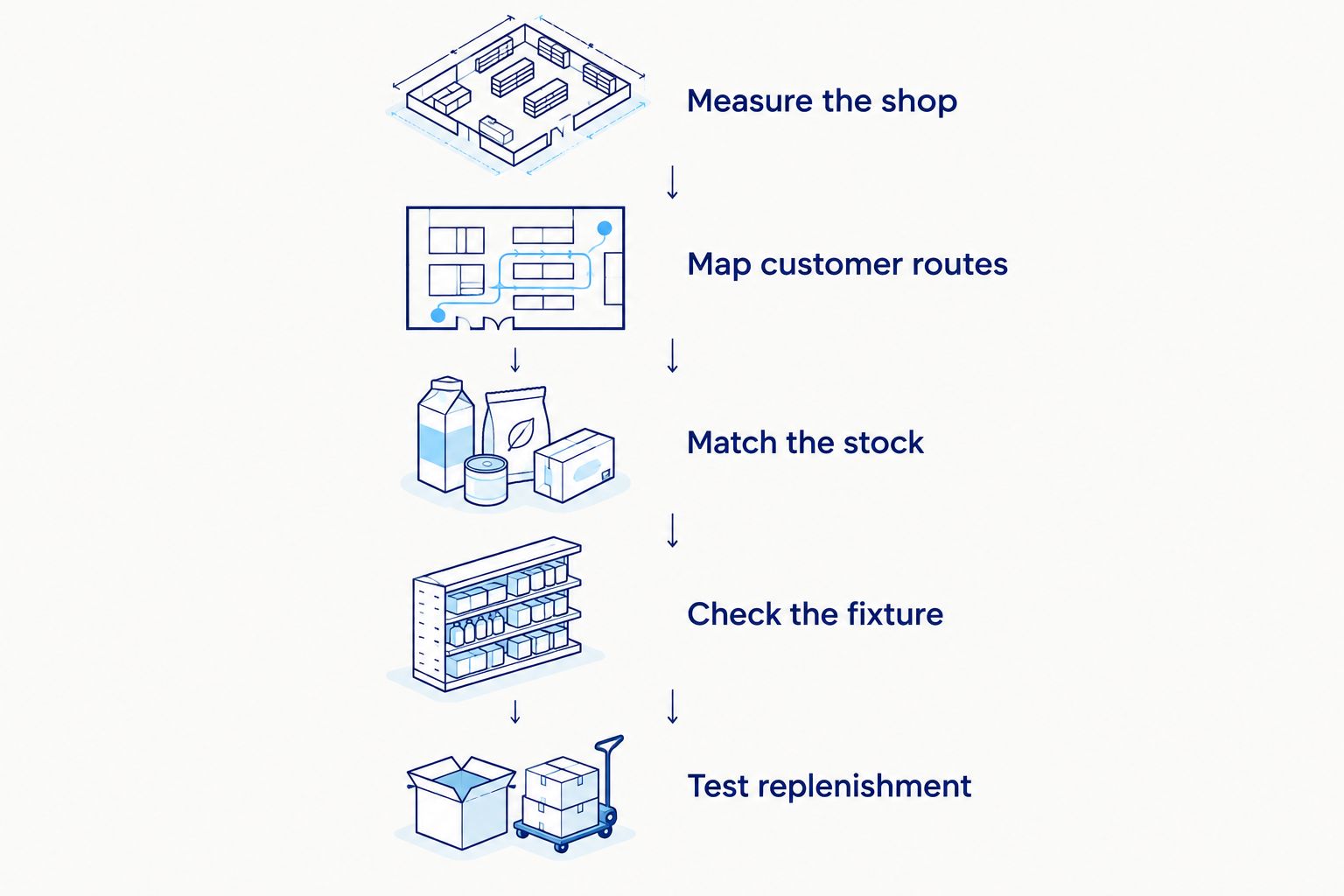
Repeat the walk-through with someone standing where a customer would browse. An empty-floor inspection does not test whether staff can replenish while another person uses the aisle.
Choose shelf depth from the groceries you intend to display and the space available around the fixture. Base shelf depth alone does not describe the complete installed footprint.
Cheapshelving lists Budget Shelving Flat Panel options with 300mm and 450mm base shelves, while supplied Heavy Duty Shelving listings include 470mm base shelves. Those are stated base shelf dimensions, not evidence that every configuration shares the same overall dimensions, upper shelves or load rating.
| Listed base shelf dimension | Best for assessing | Buying check | Limitation to resolve |
|---|---|---|---|
| 300mm | A layout where projection into the shop is a concern | Test the intended grocery packs against the proposed shelf | Pack depth still has to suit the display |
| 450mm | A range needing comparison with a deeper base option | Compare stock presentation and remaining floor space | More shelf depth occupies more of the floor plan |
| 470mm | The listed heavy-duty configurations using this base dimension | Confirm the complete configuration and intended load | The product name does not establish a load rating |
Do not select a deeper shelf simply to put more stock behind the front-facing packs. Check whether staff can rotate and retrieve that stock without disturbing neighbouring products.
For your 2026 buying brief, record base dimensions separately from total fixture dimensions. This prevents a base shelf measurement being mistaken for the width of an entire double-sided run.
Gondola shelving needs a workable ticketing arrangement as well as a stock layout. Decide where each product's label belongs, how staff identify the corresponding item and how a changed ticket reaches the correct shelf position.
Where Square is part of the store's process, printing price tags with Square belongs in the shelf-reset workflow: match the printed ticket to the product and check its placement before the display returns to use. Printing a ticket does not replace that shelf-level check.
Check shelf-edge dimensions and holder compatibility before ordering ticketing accessories. A label system should fit the chosen shelving and the information your store needs to display, rather than being added after every shelf is loaded.
Assign responsibility for removing superseded tickets during resets. The fixture can organise the display, but staff still need a consistent process for keeping the product and its shelf label together.
Cheapshelving is best for Perth and WA retailers sourcing commercial shelving and shop fittings. The business describes its experience as servicing WA businesses since 2009; your buying decision should still rest on the details of the proposed configuration.
Cheapshelving supplies commercial shelving and retail display equipment. Take a measured layout and representative pack dimensions into the enquiry so the discussion concerns your grocery store rather than an unspecified shelving bay.
Ask the supplier to confirm:
The advantage is access to commercial shelving and shop fittings from the same business. The limit is that a product listing alone does not settle whether a configuration suits your floor plan, grocery weights or installation conditions.
Gondola shelving is better only when it fixes a specific problem with the existing display. Document poor pack fit, insufficient category space, unsuitable ticketing or an awkward replenishment route before deciding to replace usable fixtures.
If a reset resolves the problem, retain the existing shelving and confirm that its condition and loading remain suitable.
A small grocery store can use wall shelving without centre gondolas when its range fits the usable perimeter display. Keep the centre available where customer movement, checkout activity or access to refrigeration needs that space.
Add a centre run only when both the stock requirement and the floor-plan test support it.
Gondola shelving does not guarantee better grocery sales. It changes how stock is displayed, but that alone does not establish a sales result or a payback period.
For a 2026 fit-out, assess practical outcomes you can observe: whether products fit, labels align, routes stay usable and replenishment works as planned.
Is gondola shelving worth it for a very small grocery store?
Gondola shelving is worth it when the display capacity fits your range without compromising customer and staff access. Start with wall shelving if a centre run would crowd the shop.
What's the best gondola layout for a narrow grocery shop?
Wall shelving is the best starting point when usable wall space exists and the central route needs to remain open. Test the full fixture footprint against doors, checkout activity and refrigeration access.
Should I choose a 300mm or 450mm base shelf?
Choose a 300mm or 450mm base shelf by checking your pack dimensions and the complete installed layout. Neither base dimension establishes the fixture's overall footprint or load rating.
Can gondola shelving hold heavy tins and bottles?
Suitability for heavy tins and bottles depends on the documented load limits of the exact shelves and bay. Confirm loading requirements before allocating those grocery lines.
Can I add more shelving later?
Plan later additions only after confirming component compatibility with the supplier. Similar-looking shelves, brackets and uprights are not evidence of compatibility.
What should a complete shelving enquiry include?
A complete shelving enquiry should include your measured layout, intended grocery range and required configuration. Ask for the component list, overall dimensions, load information and installation requirements.
Does Cheapshelving supply commercial shelving for retailers?
Cheapshelving supplies commercial shelving, retail displays, trolleys and shop fittings to businesses and retailers in Perth, Western Australia. Confirm the proposed configuration against your grocery store's layout and stock needs.
Test the least convenient task, not just the neatest display. Before approving the layout, walk through replacing a low-shelf item while a customer browses nearby and another approaches the checkout.
If that task exposes a blocked route, revise the plan before ordering. A small grocery store benefits from shelving that works during ordinary trading, not merely when the floor is empty.
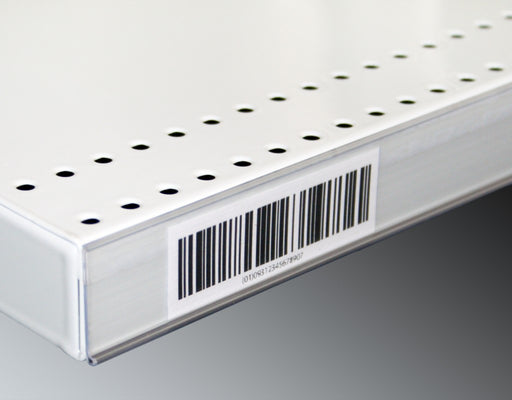
Upgrade your store's pricing and product labeling system with our Flat Adhesive Data Stripping. This cost-effective solution is designed to simplif...
View full details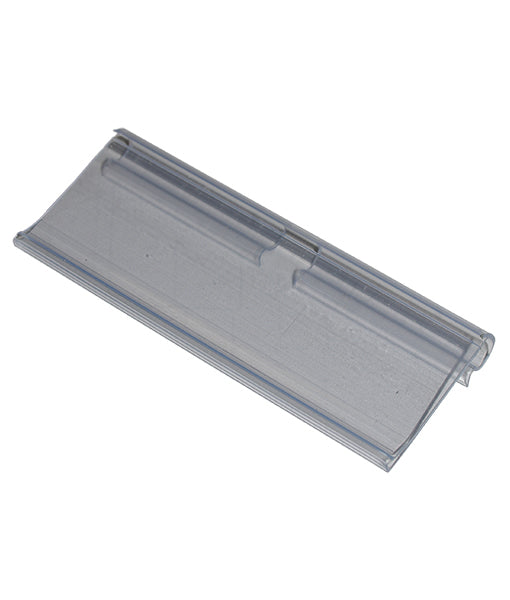
Enhance your store's product labeling and pricing system with our 100-Pack Flipper Tags. These versatile and easy-to-use tags are designed to strea...
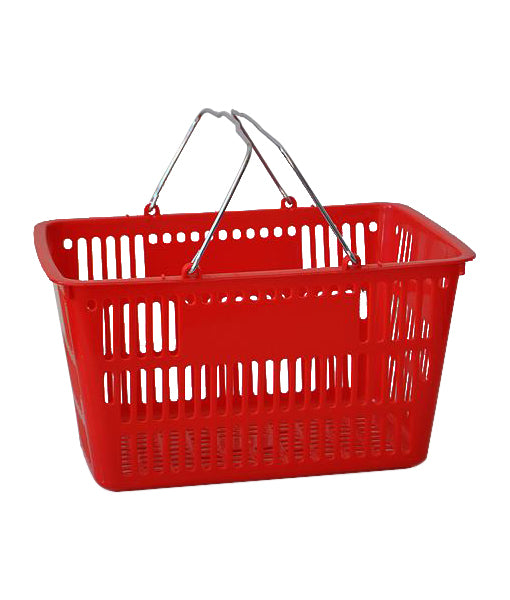
View full detailsUpgrade your customers' shopping experience with our 28 litre Shopping Baskets featuring Metal Handles. These robust and stylish baskets are design...
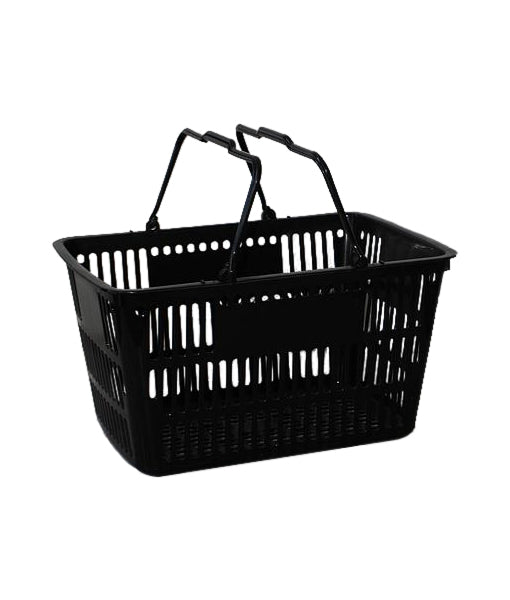
View full detailsMake shopping a breeze for your customers with our 28 Litre Shopping Baskets featuring Plastic Handles. These lightweight and sturdy baskets are de...
View full detailsRevolutionize your customers' shopping experience with our Roller Shopping Baskets. These innovative baskets are designed for maximum convenience, ...
View full details{"one"=>"Select 2 or 3 items to compare", "other"=>"{{ count }} of 3 items selected"}