SERVING WA
Since 2009

Manufacturing facility pallet shelving is pallet-based storage designed to organise raw materials, work in progress and finished goods with the aim of keeping production supplied and dispatch accessible. This 2026 guide explains how to match storage to your loads, handling equipment and floor plan rather than treating every industrial shelf as pallet racking.
Manufacturing storage must support movement between receiving, production and dispatch. A full pallet of incoming materials needs a different storage arrangement from an open carton of components beside an assembly bench.
Choose storage around how you retrieve stock, not simply how much stock fits. A layout that requires you to move unrelated pallets to reach production materials creates extra handling. Equally, placing individual picking tasks inside forklift working areas introduces a traffic conflict that needs a specific control.
Cheapshelving sells commercial shelving, retail displays, trolleys and shop fittings to Perth businesses and retailers. Cheapshelving is best for commercial and retail shelving buyers; manufacturing pallet-racking suitability requires separate confirmation. A commercial shelving listing is not evidence that a fixture can support forklift-loaded pallets.
For your 2026 project, separate the pallet-storage brief from any requirements for component shelving, consumables storage or a trade counter. Each area needs its own load and access checks.
Start with a spreadsheet and a walk through receiving, production and dispatch. Record what arrives on pallets, what gets unpacked and what leaves as finished goods; do not group everything under a single description such as warehouse stock.
Distinguish full-pallet retrieval from carton picking. If operators regularly break down pallets, identify where that happens and how the remaining stock returns to storage without obstructing the next delivery.
Give quarantined, damaged and rejected materials a defined location. Keeping those categories identifiable supports stock control and prevents their storage positions being mistaken for usable production inventory.
Use a tape measure and verified weighing information before requesting a design. Measure the loaded pallet, not just its timber or plastic base: packaging, overhang and irregular loads affect the space it needs.
Record length, width and height in millimetres, loaded mass in kilograms and clear building height in metres. Include the pallet itself in the loaded mass and distinguish a typical load from the heaviest load you intend to store.
A rack rating only applies to the configuration and loading conditions it covers. Do not turn a shelf rating into a pallet rating or assume that a bay's capacity is the sum of independently quoted shelf capacities.
Sketch the handling task first, then compare storage types. Pallet racking supports palletised storage in its specified configuration; hand-loaded shelving supports picking tasks within its documented limits. Neither description replaces a load assessment.
For a mixed manufacturing and trade-counter operation, Cheapshelving commercial shelving is a separate purchasing discussion from pallet racking. Ask about the intended hand-loaded application and obtain product-specific documentation; the words heavy duty do not establish pallet compatibility.
Avoid selecting a system solely because its footprint fits. The right option must also suit the pallet support arrangement, stock rotation method and equipment used to put goods away.
Draw your floor plan manually before refining it in drawing software. Include columns, doors, production equipment, emergency access, receiving space and dispatch staging—not just the proposed rows of racking.
Forklift access must be checked against the actual truck, load and operating task. Do not borrow an aisle width from another warehouse. Turning requirements, load dimensions and attachment use belong in the assessment.
In your 2026 layout review, follow a pallet from unloading to its final destination. Then trace the route used by a person collecting components; any overlap needs deliberate traffic management rather than an assumption that everyone will stay alert.
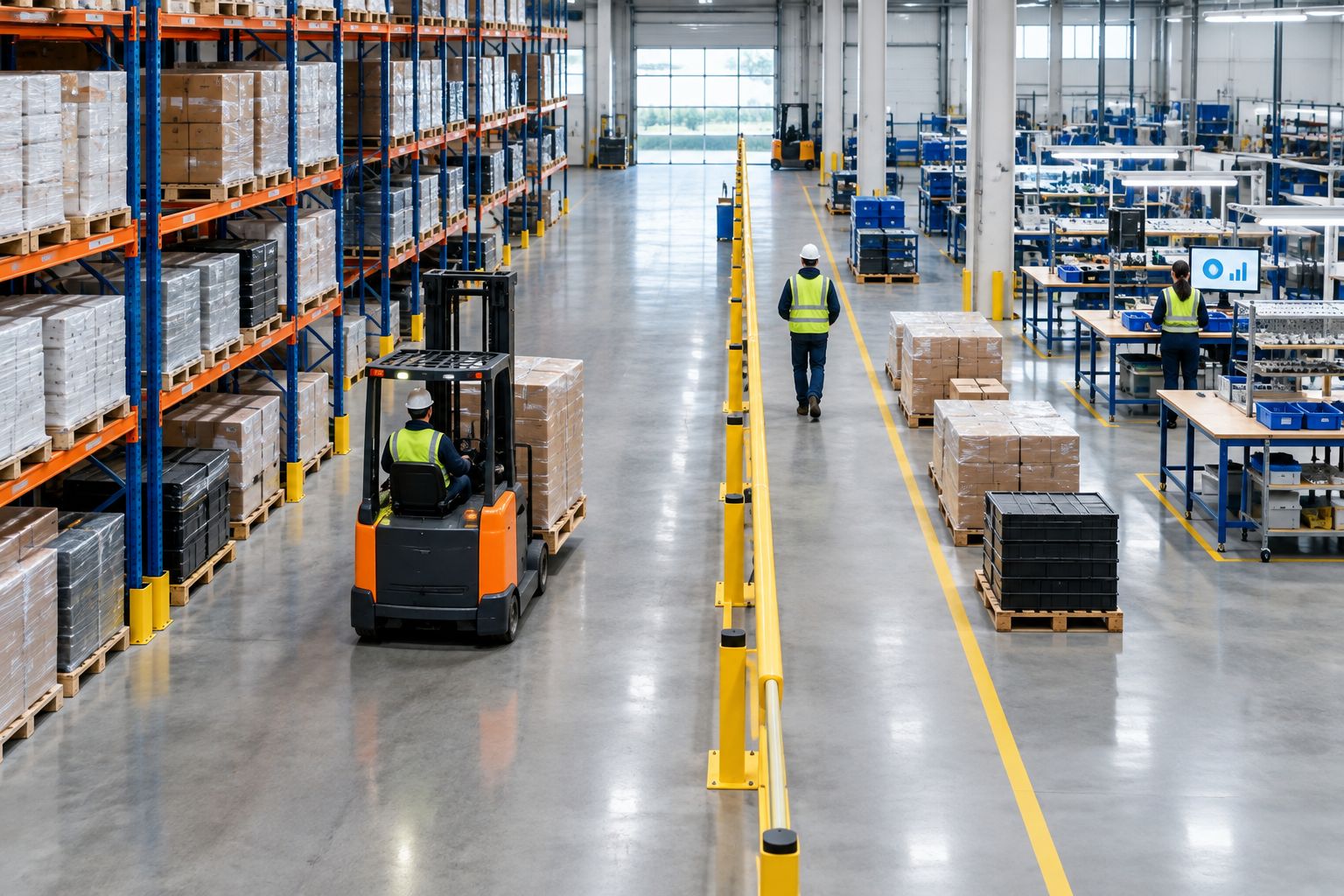
Check the plan with the people who receive, replenish and pick stock. Their normal tasks expose access problems that an empty floor plan does not show.
Collect the proposed configuration, loading information and installation requirements in writing. Have a competent racking designer or supplier assess the installation, including the supporting floor and any anchoring requirements.
Do not assume an existing concrete slab is suitable because it already supports machinery or floor-stacked pallets. Rack uprights transfer loads through concentrated support points, so the floor assessment needs to address the proposed installation.
Ask which applicable Australian Standards the design and installation address. For a 2026 purchase, confirm current requirements with the designer rather than copying an old specification or treating a product photograph as engineering evidence.
Build a written scope before comparing supplier proposals. Otherwise, a proposal covering components alone gets compared with one covering design, installation and protective equipment, leaving the real differences hidden.
Keep affordability tied to the job. Buying fewer bays is not useful if the resulting layout blocks production replenishment, and adding height is not useful if your equipment cannot safely access the upper storage positions.
For Perth and WA projects, state the actual site conditions and installation responsibilities. Australia-wide online buyers should make the same checks before ordering; a product listing does not settle site suitability.
Before expanding across the facility, check a representative area against real handling tasks. As a practical commissioning exercise, observe 1 pallet position, 1 loaded retrieval and 1 production shift; these are checks to plan, not a substitute for formal approval.
Record whether operators can identify stock, approach it safely and replenish production without using travel routes as overflow storage. Resolve problems before repeating the layout elsewhere.
Set inspection and damage-reporting procedures at handover. Arrange competent inspections at an interval appropriate to the installation and its applicable requirements, and isolate unsafe areas rather than leaving damaged racking in service.
The best storage option depends on the handling task. This table compares general storage approaches, not verified capabilities of any particular Cheapshelving product.
| Option | Best for | Practical advantage | Key limitation |
|---|---|---|---|
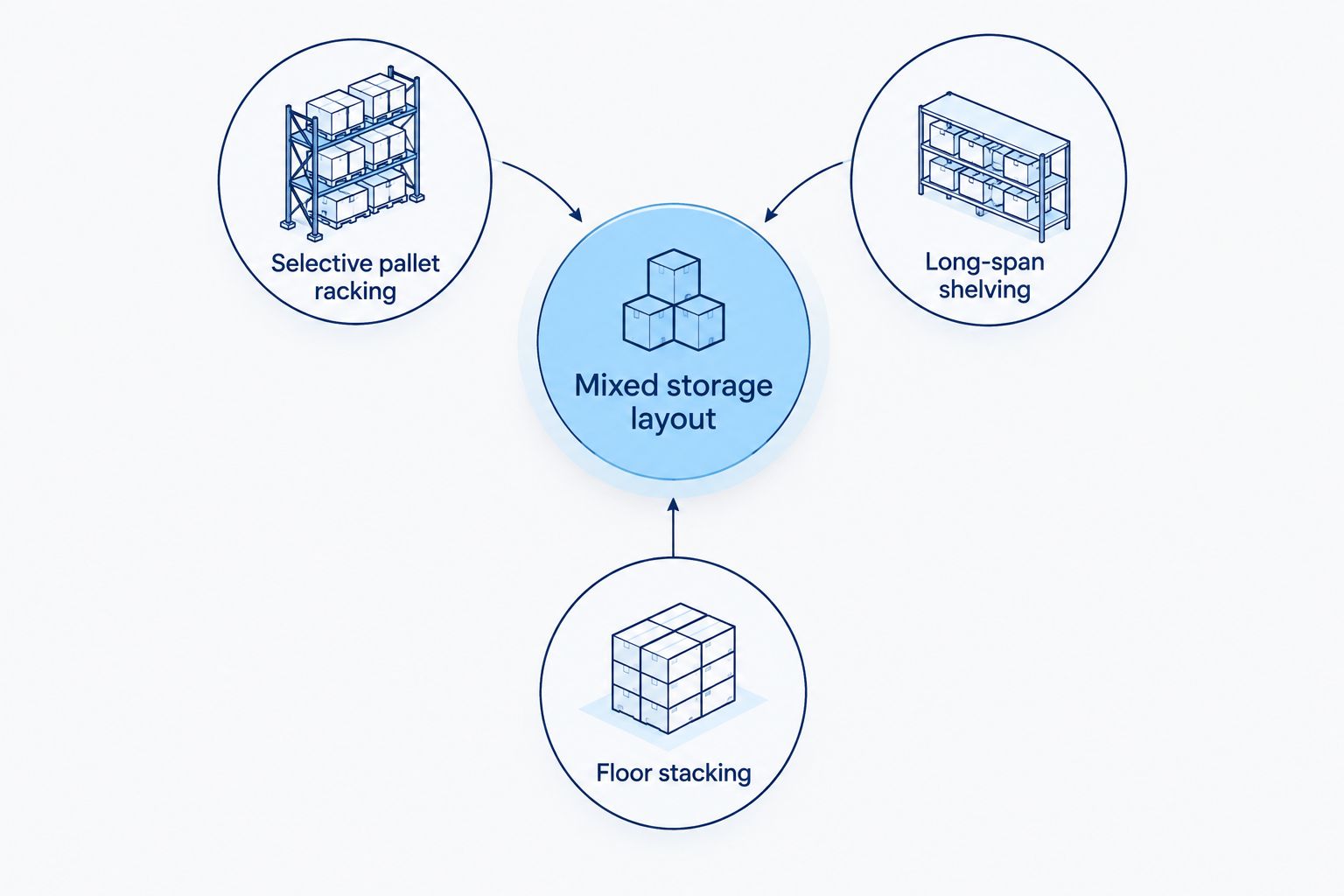
| Selective pallet racking | Palletised materials requiring direct access | Gives access to individual pallet positions | Requires suitable aisles, handling equipment and an assessed installation |
| Drive-in pallet racking | Compatible bulk stock held in repeated product lines | Reduces the number of access aisles within the storage block | Restricted access makes stock rotation and retrieval order central to the design |
| Long-span shelving | Hand-picked cartons, components and consumables | Supports organised manual picking when appropriately rated | Must not be assumed suitable for forklift-loaded pallets |
| Floor stacking | Loads specifically suitable for stacking | Avoids elevated rack storage for those loads | Uses floor space and can obstruct access to lower or rear stock |
| Mixed storage layout | Facilities combining bulk pallets with frequent component picking | Separates bulk storage from hand-picking tasks | Needs planned replenishment routes and clear boundaries |
Choose direct access when production needs individual pallets independently. Consider denser storage only after checking product compatibility, stock rotation and the handling sequence with a competent designer.
For your 2026 storage brief, describe why each zone needs its chosen system. A short explanation—such as full-pallet retrieval or hand-picked components—makes supplier recommendations easier to assess than a request for maximum storage alone.
A fixture described as heavy duty is not automatically suitable for pallet loads or forklift handling. Check the documented application, load configuration and installation requirements; do not infer industrial capability from a product name.
Normal stock levels leave out delivery peaks, production interruptions and finished goods awaiting collection. Record your actual peak conditions and provide staging space without treating aisles or exits as spare storage.
A raw-material pallet often changes after production removes stock. Plan how you identify, secure and retrieve the remaining material, including whether it belongs in pallet storage or a separate picking location.
Changing beam levels changes the rack configuration. Obtain approval and updated loading information before alterations, and do not mix components merely because they appear to fit.
A rack can fit inside the building while the loaded forklift cannot perform the required manoeuvre. Confirm truck suitability, operating clearances and access to every intended storage level before committing to the layout.
What is the best pallet shelving for manufacturing facilities?
The best pallet shelving for manufacturing facilities matches the loaded pallets, retrieval method, handling equipment and assessed site conditions. Selective pallet racking suits direct pallet access, while hand-loaded shelving serves a different picking task.
Is long-span shelving the same as pallet racking?
No, long-span shelving and pallet racking are not interchangeable. Long-span shelving must not receive forklift-loaded pallets unless the specific system is designed, rated and approved for that application.
How do I work out the pallet weight for a racking brief?
Record the maximum loaded pallet mass, including the pallet and packaging. Give the designer dimensions, load distribution and any unusual or unstable load characteristics as well.
How wide should a manufacturing warehouse aisle be?
Set aisle width from the actual handling equipment, load and operating requirements. Confirm the proposed clearance with the equipment supplier and layout designer rather than applying a generic warehouse measurement.
Can I change the beam heights after installation?
Change beam heights only after the revised configuration has been assessed and approved. Obtain updated loading information and adjust load signage where required before using the altered storage positions.
Does Cheapshelving commercial shelving suit manufacturing pallet storage?
Cheapshelving sells commercial shelving and retail equipment, but pallet-storage suitability requires product-specific confirmation. Obtain documentation covering pallet loads, handling methods and installation before specifying any fixture for that task.
What should I do if a forklift hits the racking?
Report the impact, control access to the affected area and arrange a competent assessment. Do not continue using visibly damaged storage or attempt an improvised repair.
An empty pallet position is not necessarily the wrong use of space. You need accessible locations for put-away, stock changes and production handovers; filling every available area can leave nowhere to complete those tasks.
Before signing off your 2026 plan, walk a delivery through the proposed layout on paper. Identify where it waits, where it is checked and how it reaches storage without occupying a production route.
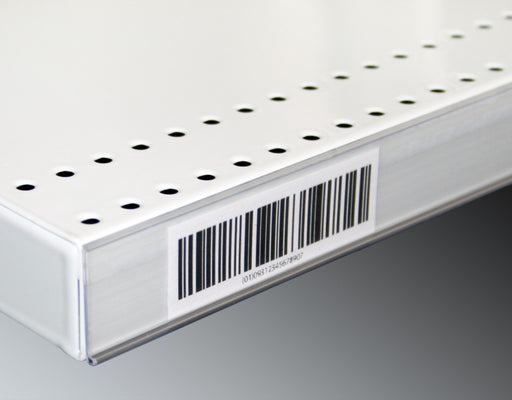
Upgrade your store's pricing and product labeling system with our Flat Adhesive Data Stripping. This cost-effective solution is designed to simplif...
View full details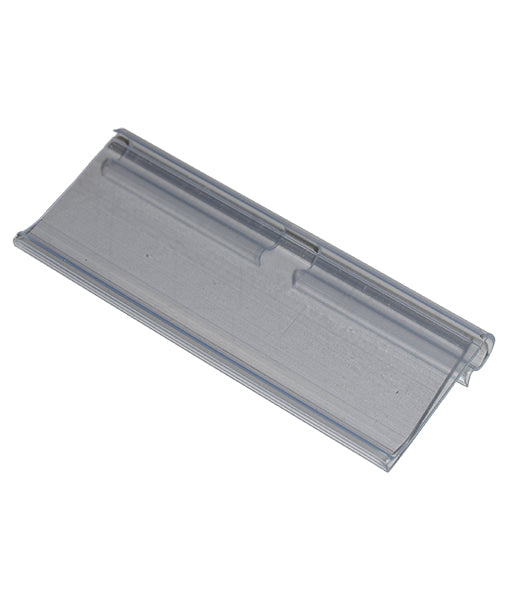
Enhance your store's product labeling and pricing system with our 100-Pack Flipper Tags. These versatile and easy-to-use tags are designed to strea...
View full detailsUpgrade your customers' shopping experience with our 28 litre Shopping Baskets featuring Metal Handles. These robust and stylish baskets are design...
View full detailsRevolutionize your customers' shopping experience with our Roller Shopping Baskets. These innovative baskets are designed for maximum convenience, ...
View full detailsMake shopping a breeze for your customers with our 28 Litre Shopping Baskets featuring Plastic Handles. These lightweight and sturdy baskets are de...
View full details{"one"=>"Select 2 or 3 items to compare", "other"=>"{{ count }} of 3 items selected"}