SERVING WA
Since 2009

Best overall: Long Span Shelving for mixed, hand-picked cartons. Best for narrow stockrooms: shallow shelving; best for loose small items: divided shelving; best budget approach: retain suitable existing shelving before expanding. This 2026 guide compares long span shelving for stockrooms by stock fit, access, floor space and buying checks.
Your stockroom needs to support replenishment, not just hold cartons. A shelf that fits more stock but makes the rear cartons difficult to reach creates a handling problem rather than solving a storage problem.
Cheapshelving sells commercial shelving and retail equipment to businesses and retailers in Perth, Western Australia. The right purchase starts with your stock profile and room measurements, whether you operate in WA or buy online elsewhere in Australia.
Choose the shelving layout before choosing the largest bay. If your stockroom also handles warehouse-style storage, the guide to long span shelving for a small warehouse covers the adjacent buying decision.
Use these criteria for your 2026 shortlist. They separate useful storage capacity from space that looks good on a drawing but is awkward during replenishment.
These are different storage approaches, not interchangeable long span products. Long Span Shelving is the named product; the other entries describe configurations or purchasing decisions.
| Rank | Option | Best for | Standout feature | Key limitation |
|---|---|---|---|---|
| 1 | Long Span Shelving | Mixed hand-picked cartons | Storage-led starting point for a carton stockroom | Dimensions and load ratings need confirmation |
| 2 | Shallow shelving | Constrained wall runs | Shelf depth selected around room access | Less depth for bulky cartons |
| 3 | Divided shelving | Loose small-item backstock | Separate locations within a shelf | Dividers do not increase structural capacity |
| 4 | Retain existing shelving | Avoiding unnecessary replacement | Keeps suitable fixtures in use | Requires a condition and suitability check |
Long Span Shelving is the first option to assess when your main task is storing and picking retail cartons. Cheapshelving describes Long Span Shelving as a storage and display option for Australian retail businesses; final suitability depends on the configuration specified for your stock.
Start with the cartons you actually receive. Record their dimensions and loaded weights, then ask for usable shelf dimensions and documented capacities rather than choosing from a product photograph.
Long Span Shelving pros:
Long Span Shelving cons:
Best for: Retail stockrooms where staff replenish the shop floor from hand-picked cartons.
For a Perth retailer holding varied backstock, specify the busiest replenishment lines first. Then allocate slower-moving stock around those working locations, rather than giving every product the same amount of shelf space.
Verdict: Buy only after the proposed dimensions, capacities and installation requirements match your stockroom.
Shallow shelving is a configuration choice for rooms where access matters more than deep storage. It deserves a place on your shortlist when deeper shelving would obstruct a doorway, packing area or replenishment route.
Cheapshelving lists Budget Shelving Flat Panel products with 300mm and 450mm base shelves. Those measurements describe the named base shelves—not the complete installed footprint, upper shelf dimensions or load capacity—and these products are alternatives to assess, not long span specifications.
Shallow shelving pros:
Shallow shelving cons:
Best for: Narrow rooms storing smaller cartons along available walls.
Measure the full installed projection from the wall, including feet and any projecting components. Check the remaining space with doors open and your stock-handling equipment in its working position.
Verdict: Buy when the complete footprint preserves access and the specified shelves suit your cartons.
Divided shelving separates loose products into identifiable lanes or locations. It addresses an organisation problem: small units that become difficult to identify when stored together on an open shelf.
Cheapshelving lists Acrylic Shelf Dividers, a 1200mm Acrylic T-Rail, and a 1200mm Acrylic T-Rail with a 35mm front riser. Confirm the rail, divider and shelf combination before ordering; those product dimensions do not establish compatibility with Long Span Shelving.
Divided shelving pros:
Divided shelving cons:
Best for: Loose accessories, small packaged products and opened-carton stock that needs separation.
Keep full cartons and loose units distinct in your layout. A shelf organised for individual units serves a different picking task from a reserve shelf holding unopened cartons.
Verdict: Buy compatible dividers for a defined small-item zone; skip them as a substitute for suitable shelving.
Retaining suitable shelving is a purchasing decision, not a claim that old fixtures are always adequate. Start by checking condition, identifying the system and confirming the intended load and configuration.
If your shelving already fits the stock, better location labels and a revised allocation of shelf space are worth assessing before replacement. Do not extend an unidentified system with parts that merely look similar.
Retaining existing shelving pros:
Retaining existing shelving cons:
Best for: Stores with identifiable, sound shelving that already suits the intended stock.
Compare your existing layout against the same criteria used for new shelving. Reuse is only a useful budget approach when it preserves safe, practical access and suitable storage.
Verdict: Hold the replacement order until existing shelving has been assessed; skip reuse where suitability cannot be established.
For a 2026 fitout, build the shelving brief around four steps: Measure stock, Map access, Confirm loads and Check components. Send the same brief with every enquiry so that quotes describe comparable arrangements.
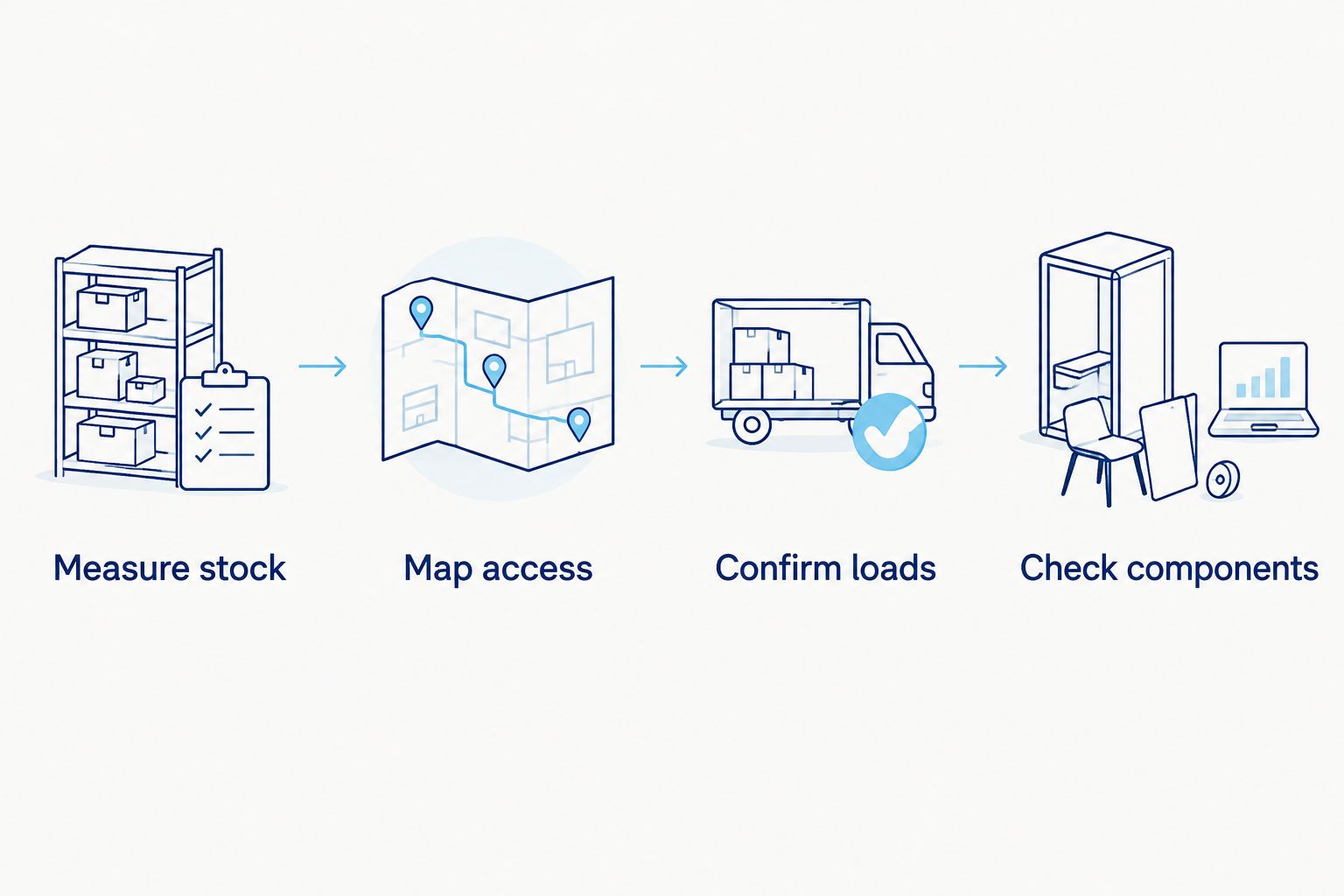
Record carton width, depth, height and loaded weight. Include the largest awkward carton as well as the products that occupy most of your storage; designing only around an average carton leaves exceptions unresolved.
Draw door swings, fixed equipment, packing surfaces and the route between receiving, storage and the shop floor. Check the working route, not just the empty room.
Ask for shelf and bay capacities for the proposed configuration, including any loading conditions. Keep these specifications with the stockroom plan so later changes do not rely on memory.
Request an itemised description of the proposed shelving and required installation work. Confirm which components and accessories belong to that system before approving substitutions or additions.
A useful 2026 comparison covers a complete working arrangement, not just a bay name. Ask suppliers to describe exactly what the proposed configuration includes and what you must arrange separately.
For Australian online buyers, these checks matter before approving an order. A clear written brief is more useful than assuming a familiar-looking shelf will fit an existing system.
The 2026 ranking prioritises stock fit, picking access, documented capacity, floor-space use and purchase scope. It is a decision guide, not a load-test ranking or a claim that one shelving system outperforms another.
Long Span Shelving leads for the article's mixed-carton use case. Shallow shelving, divided storage and retaining existing fixtures each address a different constraint; none automatically replaces the others across an entire stockroom.
For mixed-carton retail storage, shortlist Cheapshelving Long Span Shelving first, then confirm its fit against your stock and room measurements. Choose shallow shelving where depth limits access, and add compatible divided storage where loose products need separate locations.
If the current shelving already meets those needs, assess it before replacing it. The best purchase solves an identified storage problem without creating a new picking or access problem.
What's the best long span shelving for a retail stockroom?
Long Span Shelving is the first option to shortlist for a mixed-carton retail stockroom. Choose the final configuration only after matching usable shelf dimensions, documented capacities and access requirements to your stock.
Is long span shelving suitable for a small stockroom?
Long span shelving suits a small stockroom only when its complete footprint and storage dimensions fit the room. Check doors, working areas and replenishment routes before selecting a bay.
How much weight can long span shelving hold?
Use the documented capacity for the exact shelf, bay and configuration being purchased. Do not infer a rating from the words long span or heavy duty, or transfer a rating from another shelving product.
Should I choose 300mm or 450mm shelving for my stockroom?
Choose shelf depth around your carton dimensions and remaining working space. The 300mm and 450mm measurements discussed here refer to named Budget Shelving base shelves, not Long Span Shelving specifications or complete installed footprints.
Can I add acrylic dividers to long span shelving?
Add acrylic dividers only after confirming that the dividers, rails and shelving are compatible. Divider accessories organise stock but do not increase the structural capacity of the shelf.
Do I need to replace all my existing stockroom shelving?
Replace shelving according to condition and suitability, not simply because the stockroom is disorganised. Identify the existing system and confirm its capacity before deciding whether to retain, alter or replace it.
What should I ask Cheapshelving before ordering stockroom shelving?
Ask Cheapshelving to confirm usable shelf dimensions, shelf and bay capacities, included components and installation requirements. Provide your carton measurements and room plan so the proposed arrangement can be checked against the intended use.
Before committing to a 2026 layout, mark the proposed shelving footprint on the floor and walk the replenishment route with the equipment you use. Open the doors and stand at the packing area: an empty-room sketch does not show how those tasks compete for space.
Do not buy extra shelf depth unless your stock can use it and your staff can reach it. That check belongs before the order, not after assembly.
Upgrade your store's pricing and product labeling system with our Flat Adhesive Data Stripping. This cost-effective solution is designed to simplif...
View full details
Enhance your store's product labeling and pricing system with our 100-Pack Flipper Tags. These versatile and easy-to-use tags are designed to strea...
View full detailsUpgrade your customers' shopping experience with our 28 litre Shopping Baskets featuring Metal Handles. These robust and stylish baskets are design...
View full detailsMake shopping a breeze for your customers with our 28 Litre Shopping Baskets featuring Plastic Handles. These lightweight and sturdy baskets are de...
View full detailsRevolutionize your customers' shopping experience with our Roller Shopping Baskets. These innovative baskets are designed for maximum convenience, ...
View full details{"one"=>"Select 2 or 3 items to compare", "other"=>"{{ count }} of 3 items selected"}