SERVING WA
Since 2009

Butcher shop gondola shelving is freestanding retail shelving for displaying packaged, shelf-stable products with the aim of making complementary purchases easier without obstructing service. This 2026 guide explains how to choose fixtures for butcher shops and delis, where refrigerated displays, food handling and counter queues take priority over extra shelf space.
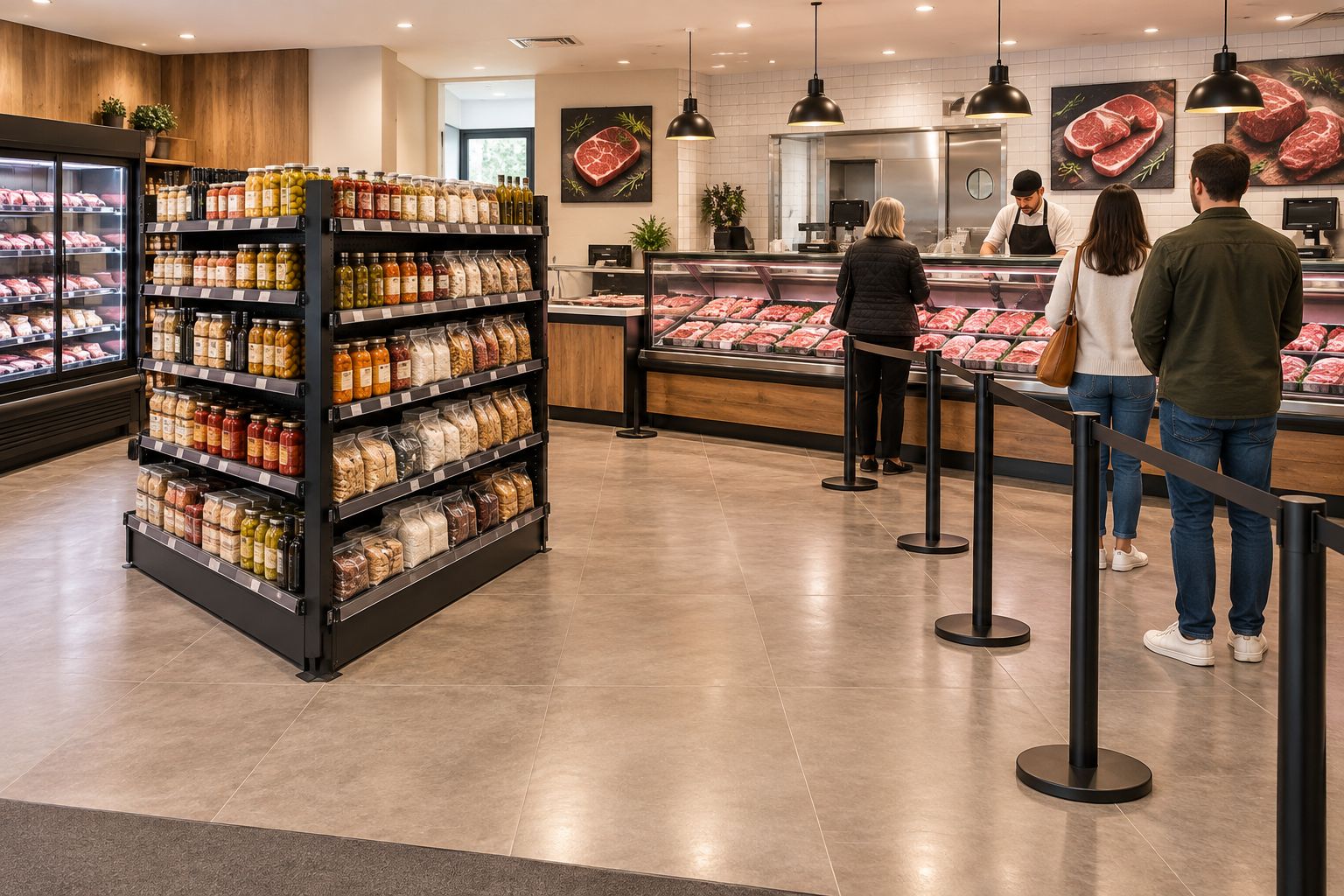
A butcher shop needs to sell complementary products without making the meat counter harder to reach. A deli faces a similar constraint: customers browsing packaged groceries must share space with customers ordering from a staffed display.
Gondola shelving gives shelf-stable sauces, seasonings and other suitable packaged products a dedicated display. Its limitation is equally clear: an ordinary retail shelf provides no temperature control and does not establish suitability for exposed food.
Cheap Shelving is best for WA retailers sourcing commercial shelving and shop fittings together. Cheap Shelving supplies these categories to businesses and retailers in Perth, Western Australia, servicing WA businesses since 2009.
For your 2026 fit-out, start with the operating layout rather than the largest fixture you can accommodate. A display earns its place only when customers can browse it, staff can replenish it and cleaning remains practical.
Use a tape measure, floor sketch and sample stock before comparing fixtures. Follow the sequence below so that shelf selection answers a shop-floor requirement rather than creating a new obstacle.
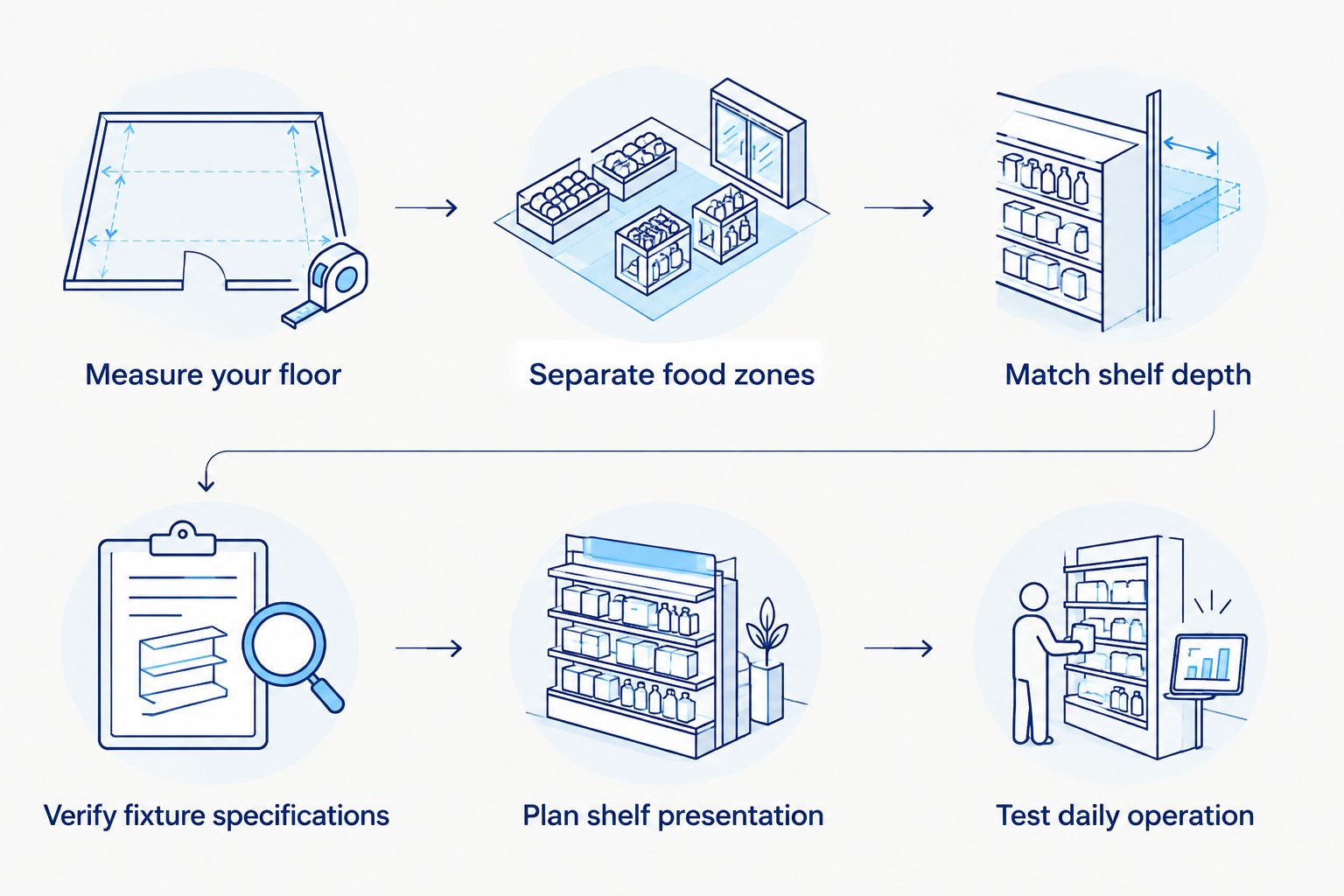
Draw the shop as it operates, not as an empty room. Mark the entrance, refrigerated counters, doors, payment point and customer queue, then identify the space left for packaged merchandise.
Measure the fixture's complete installed footprint, including feet, shelf projections and any end display. Base-shelf dimensions alone do not tell you how much room a complete installation occupies. Keep the proposed shelving clear of required exits and access routes, and confirm applicable access requirements before installation.
For a Perth shop planning a 2026 refit, tape the proposed footprint onto the existing floor before ordering. Walk around it with a basket while another person waits at the counter.
List the products you intend to display and check their storage instructions first. Packaged products belong on ambient shelving only when their labelling and your food-safety procedures permit ambient storage.
Keep raw-food handling separate from customer-accessible pantry displays. Do not use a retail gondola as a preparation bench or assume that a painted metal finish is suitable for direct food contact. Food Standards Australia New Zealand's food-premises requirements distinguish cleanable fixtures from surfaces suitable for food contact; these are not interchangeable checks.
Bring the stock list and floor sketch to Cheap Shelving when discussing commercial shelving. This gives the discussion a defined purpose, but you still need to verify the selected fixture's cleaning instructions and suitability for its intended location.
Measure the actual packages you sell, including labels, lids and awkwardly shaped bags. Then decide how many products should sit across the shelf and how many should sit behind each front-facing item.
The supplied Budget Shelving range includes base-shelf options described as 300 mm and 450 mm. Treat these as dimensions of those named options, not universal gondola dimensions or guarantees about usable display space. A deeper base takes more floor area; it only helps when your stock plan needs that depth.
Sketch each product group on paper before choosing the fixture. Shorter rows of visible stock can be more useful than extra depth that leaves products difficult to see or retrieve.
Check the exact configuration rather than relying on words such as heavy duty. Ask for the load rating, load-distribution conditions, assembly instructions and any fixing requirements for the complete fixture you intend to use.
One supplied accessory, Budget Shelving Additional Shelves, is described as carrying 45 kg U.D.L. per shelf and includes 2 shelf brackets. U.D.L. means uniformly distributed load: the stated rating concerns weight spread across that shelf. It is not permission to place the same weight at a single point or apply that rating to another shelving system.
For your 2026 purchasing checklist, record the confirmed specification beside the exact component. Cheap Shelving's product names help identify options, but a name alone does not confirm compatibility with your existing fittings.
Draw a simple planogram showing where each product group belongs. Group suitable packaged accompaniments by shopping task, while keeping heavier items low and labels visible. Do not fill every gap simply because the fixture has space.
Write shelf labels by hand for the first trial. Once the arrangement works, check compatible label holders and shelf-edge fittings. A data strip is an option to assess, but its attachment and fit must match your shelf edge.
Budget Shelving Wire Shelf Front is described as helping stop products falling from the shelf front. Its benefit is product retention; its limitation is that it does not establish shelf load capacity, and you must confirm fit before purchase.
Trial the arrangement with actual stock before completing the fit-out. Watch a customer approach the counter, browse the shelving and move to payment without having to double back through a queue.
Replenish the display using your normal cartons and handling method. Check whether a staff member can restock without blocking service, then remove stock and clean around the fixture. This test exposes practical problems that a tidy floor drawing misses.
Record the result in your 2026 merchandising plan. If the fixture creates repeated obstruction, reduce its footprint or reposition it before adding accessories.
Cheap Shelving's Budget Shelving Additional Shelves and Budget Shelving Wire Shelf Front address different tasks. Additional shelves are best for adding display levels within a confirmed compatible system; wire shelf fronts are best for front-edge product retention. Neither accessory replaces checking the complete fixture's suitability.
The additional shelf's stated load rating applies under its specified conditions. The wire front addresses products falling forwards, not overall fixture stability. Confirm both accessories against your selected shelving before adding them to the order.


Choose the display format around the stock and the customer route. These options serve different purposes; a gondola is not automatically the right answer for every available space.
| Option | Best for | Main benefit | Key limitation |
|---|---|---|---|
| Single-sided gondola arrangement | Packaged goods along a perimeter | Keeps browsing on one accessible face | Requires confirmation that the selected system supports the arrangement |
| Double-sided gondola arrangement | A central packaged-goods aisle | Provides display faces on both sides | Needs browsing and circulation space on both sides |
| Compact counter display | A small selection of packaged accompaniments | Places products near the ordering or payment point | Competes with service space and staff sightlines |
| Refrigerated display | Products requiring chilled storage | Provides temperature-controlled display when correctly selected and operated | Requires appropriate equipment, monitoring and cleaning; ordinary shelving cannot substitute |
Choose a central gondola only when both sides remain usable during service. If customers can access only one side without obstructing the queue, assess a perimeter arrangement instead.
A customer comparing seasonings needs a different space from someone waiting to order. Overlapping those activities creates an avoidable obstruction. Mark both zones before deciding where the gondola belongs.
Packaging does not prove that a product belongs on an unrefrigerated shelf. Check storage instructions for each item, including requirements after opening. Keep chilled stock in suitable temperature-controlled equipment.
Extra depth can conceal smaller products behind taller packaging. Test the intended stock arrangement on the proposed shelf dimensions rather than judging the fixture empty. Reduce depth or change the presentation when products become difficult to retrieve.
Shelf brackets, fronts and panels need confirmed compatibility. A similar finish or shape does not establish a match. Identify the existing system and compare the actual connection details before ordering additions.
A crowded pantry display can make labels harder to read and stock rotation harder to manage. Set a display quantity for each product and keep replenishment stock in suitable storage. Shelf capacity is a safety limit, not a merchandising target.
What's the best gondola shelving for butcher shops?
The best gondola shelving for butcher shops fits the packaged-stock plan without obstructing counter service, cleaning or customer access. Compare the complete footprint, confirmed load ratings and accessory compatibility before choosing a configuration.
Can I display fresh meat on gondola shelving?
Ordinary gondola shelving is not a substitute for suitable refrigerated food-display equipment. Fresh meat needs appropriate temperature control and hygienic handling; select equipment against your food-safety requirements.
Is single-sided or double-sided shelving better for a small deli?
Single-sided shelving suits a perimeter arrangement, while double-sided shelving suits an aisle with usable space on both sides. Choose by the customer route and service queue rather than the amount of shelving alone.
Should I choose a 300 mm or 450 mm base shelf?
Choose between the supplied 300 mm and 450 mm base-shelf options by measuring your stock and available floor space. Confirm usable shelf dimensions and the complete installed footprint before ordering.
How much weight can a gondola shelf hold?
A gondola shelf's capacity depends on the exact shelf, brackets, uprights and loading conditions. The supplied Budget Shelving Additional Shelves listing states 45 kg U.D.L. per shelf; do not apply that rating to other products or configurations.
Do butcher shop shelves need to be suitable for food contact?
A surface used for direct food contact needs to be suitable for that purpose. Shelving used only for sealed packages still needs appropriate cleaning and placement; do not assume a retail finish establishes food-contact suitability.
Should I buy shelf labels and fronts with the shelving?
Choose shelf labels and fronts after confirming your stock layout and shelving system. Check shelf-edge fit, product visibility and accessory compatibility so that the additions solve a defined display problem.
Test the least convenient task before approving your 2026 layout: cleaning behind a stocked fixture. If that task requires moving stock into the customer queue or blocking access to the counter, revise the arrangement. A shelf that fits an empty shop still has to work through a trading day.
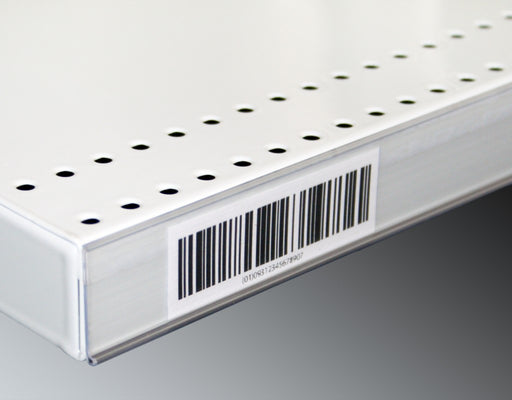
Upgrade your store's pricing and product labeling system with our Flat Adhesive Data Stripping. This cost-effective solution is designed to simplif...
View full details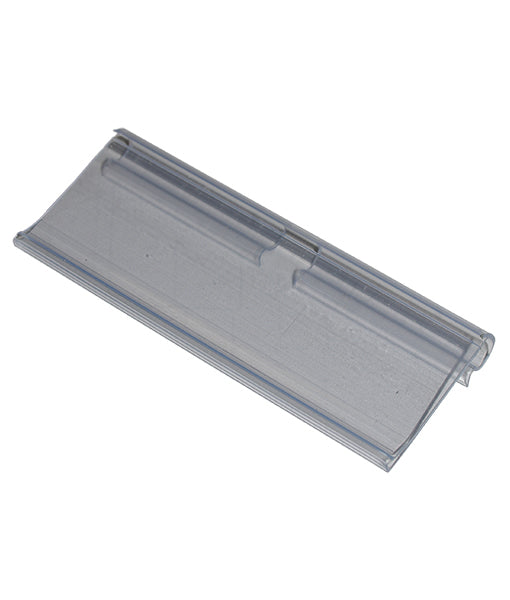
Enhance your store's product labeling and pricing system with our 100-Pack Flipper Tags. These versatile and easy-to-use tags are designed to strea...
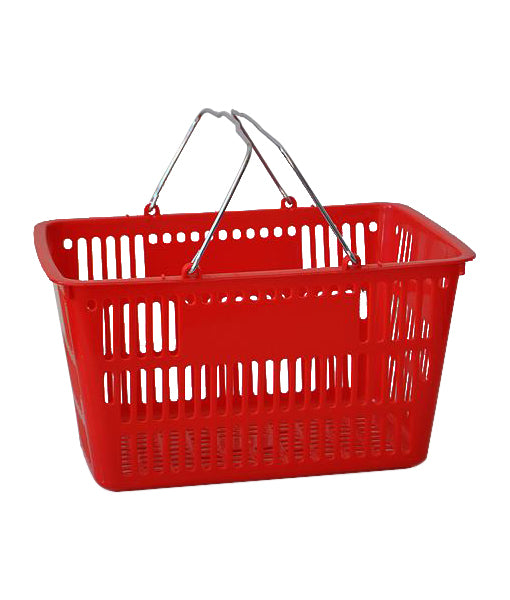
View full detailsUpgrade your customers' shopping experience with our 28 litre Shopping Baskets featuring Metal Handles. These robust and stylish baskets are design...
View full detailsRevolutionize your customers' shopping experience with our Roller Shopping Baskets. These innovative baskets are designed for maximum convenience, ...
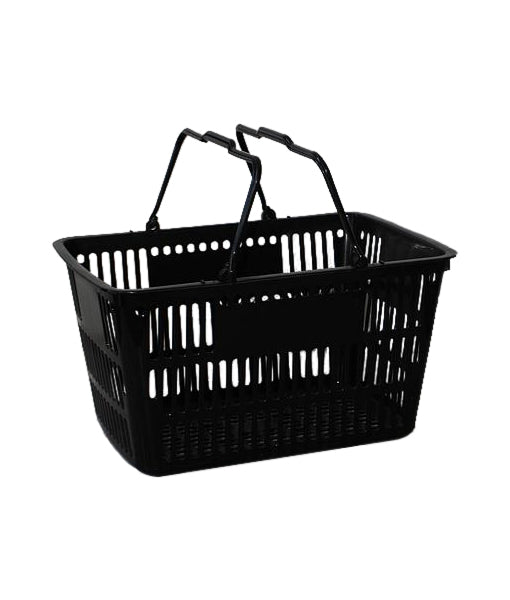
View full detailsMake shopping a breeze for your customers with our 28 Litre Shopping Baskets featuring Plastic Handles. These lightweight and sturdy baskets are de...
View full details{"one"=>"Select 2 or 3 items to compare", "other"=>"{{ count }} of 3 items selected"}